
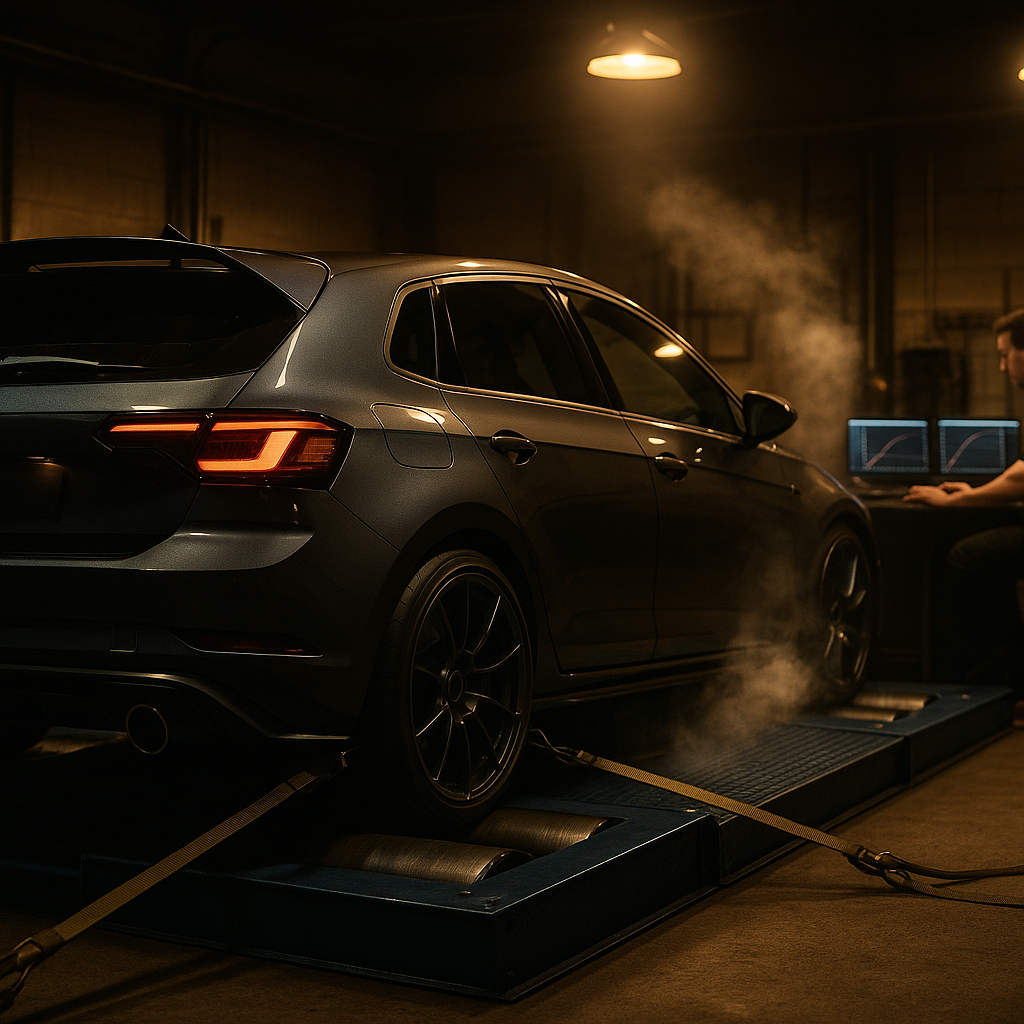
There is something almost ceremonial about strapping your car to a rolling road. The car gets wheeled into position, the technician clips on sensors, revs build to a shriek, and then a number appears on the screen. That number either makes your day or quietly ruins it. Rolling road dyno tuning in the UK has evolved from a niche workshop service into a full-blown culture, with Saturday dyno days drawing crowds of enthusiasts who treat bhp figures the way football fans treat league tables.
But not all dyno results are honest, not all workshops are equal, and not all power claims survive scrutiny. If you are serious about your build, understanding what actually happens on a rolling road is just as important as knowing which turbo you are running.
What Actually Happens on a Rolling Road Dyno Day
A rolling road, or dynamometer, measures the power your car puts down at the wheels rather than at the engine’s flywheel. Your car drives onto a set of rollers, gets strapped down with axle straps, and a load is applied as the operator makes successive pulls through the rev range. Software plots torque and power against RPM to produce those satisfying curves you see posted all over Instagram and the forums.
Most serious UK workshops use either a Dynapack hub dyno or a Bosch four-wheel-drive roller dyno for all-wheel-drive cars. Hub dynos are generally considered more accurate because they eliminate tyre slip variables. Roller dynos are more common and more accessible. Both are legitimate tools when operated properly, but the operator’s experience matters enormously. A lazy or incorrectly calibrated dyno run can swing figures by 15 to 20 bhp either direction, which is a big deal if you are chasing a specific power target.
The UK Workshops That Actually Know What They Are Doing
A handful of names consistently come up when UK enthusiasts talk about rolling road dyno tuning. Regal Autosport in Warwickshire has built a strong reputation among turbocharged VAG and Subaru owners for accurate, repeatable figures and proper remap tuning rather than just plug-and-play solutions. Up in Sheffield, Paramount Performance has been pulling big numbers from modified Fords and Hondas for years. Litchfield Motors in Gloucestershire handles some of the most exotic machinery in the country and runs a meticulous process before anything touches their rollers.
In Scotland, Abbey Motorsport in Cumbernauld has become a go-to for Mitsubishi Evo and Subaru Impreza builds. Down south, Pumaspeed in Suffolk has developed a loyal following in the Focus ST and RS community. These are not random picks; they are names that appear repeatedly in verified dyno threads on SELOC, SXOC, Briskoda, and other UK community forums where enthusiasts share real results rather than marketing material.
Reading Your Power Figures Honestly
Here is where a lot of people get burnt. A workshop claiming your car makes 380bhp sounds brilliant until you realise they measured on a warm day with the car slightly heat-soaked, on a roller dyno that is known to read slightly high, and expressed the figure as flywheel power using an estimated drivetrain loss calculation rather than actual wheel power. That same car on a properly calibrated hub dyno in cooler conditions might show 330whp. Neither figure is necessarily wrong, but they are not the same conversation.
The honest metric for rolling road dyno tuning in the UK is wheel horsepower, measured at the rollers. Flywheel figures involve adding back an assumed drivetrain loss, typically 15 to 20 per cent for a front-wheel-drive car, 18 to 22 per cent for a rear-wheel-drive car, and up to 25 per cent for four-wheel-drive setups. Some workshops use a fixed percentage, others use a calculated one. The choice affects the final number significantly. Always ask which figure you are being quoted before you start celebrating.
Atmospheric correction is another variable. Most professional dynos apply a correction factor to standardise results to a reference temperature and pressure, typically the SAE or DIN standard. This means your runs are comparable across different locations and seasons. A workshop that does not apply correction is either being naive or is gaming the numbers, and neither is a good sign.
What to Bring and How to Prepare Your Car
Turning up to a rolling road session with a car that is not ready is a waste of everyone’s time and your money. Fresh plugs, clean fuel injectors, and a recent oil change are the bare minimum. If your car has a boost leak, worn boost pipes, or a tired intercooler, a dyno session will expose every weakness in dramatic fashion. Technicians at quality workshops will often do a visual check before they let you on the rollers, and they should flag anything that looks risky.
Fuel quality matters more than most people expect. If your tune is set up for 99 RON and you arrive on supermarket 97 RON, your knock sensor will pull timing and your power figures will disappoint. Pump the tank with quality fuel the day before. For cars running flex fuel or E85 blends, make sure the fuel is at the ratio your tune expects.
The UK vehicle approval and modification guidance on gov.uk is worth reading if you are making significant engine modifications, particularly around emissions compliance for road use. A good tuning workshop will flag MOT implications during the session rather than leaving you to discover them at test time.
Why the Scene Has Grown So Much in 2026
Rolling road dyno tuning in the UK has exploded in popularity partly because ECU remapping has become so accessible. Companies like Revo, Mountune, and APR have made off-the-shelf maps available for hundreds of common platforms, meaning cars that once needed bespoke tuning can now be mapped in an afternoon. That accessibility has brought a much wider audience onto the rollers, from Golf R owners looking for a modest 50bhp bump to fully built Supra engines chasing 700bhp and beyond.
Social media has done the rest. A clean dyno sheet posted on Instagram or a timed dyno pull video on YouTube generates real engagement in the car community, and workshops have leant into that. Dyno days where five to ten cars run in sequence have become social events as much as technical ones, with enthusiasts gathering to watch, compare notes, and argue about whether a certain platform is truly tapped out at its supposed limit.
The competitive edge of knowing your actual numbers, verified on a calibrated machine by a respected tuner, carries real weight in the community. Dyno sheets get scrutinised. Claims get challenged. And that is exactly how it should be, because the culture is healthier when the numbers mean something.
Frequently Asked Questions
How much does a rolling road dyno session cost in the UK?
A standard dyno session at a UK workshop typically costs between £80 and £200 for a baseline run, depending on the number of pulls and whether a remap is included. Full map and dyno day packages can range from £300 to £700 or more for complex setups. Prices vary significantly by region and workshop reputation.
What is the difference between wheel horsepower and flywheel horsepower on a dyno?
Wheel horsepower is the power measured directly at the rollers, after drivetrain losses. Flywheel horsepower adds back an estimated percentage to account for those losses and represent what the engine produces at the crank. The difference is typically 15 to 25 per cent depending on the drivetrain layout, so always confirm which figure a workshop is quoting.
How do I find a reputable rolling road tuning workshop near me in the UK?
UK enthusiast forums like SELOC, ScoobyNet, Briskoda, and SXOC have dedicated tuning sections where members share verified dyno results and workshop recommendations. Searching for your specific car platform plus your region will usually surface the names that come up repeatedly. Avoid workshops that cannot show you previous dyno sheets or who refuse to discuss their equipment calibration.
Can a dyno day damage my car?
A properly run dyno session on a car that is in good mechanical condition carries minimal risk. The danger increases significantly if the car has existing issues such as boost leaks, weak engine internals, or poorly tuned fuelling. Most reputable UK workshops carry out a pre-run inspection and will refuse to proceed if they spot anything that could cause a failure under load.
Do dyno figures affect my car insurance in the UK?
Any modification that increases your car’s power output must be declared to your insurer, regardless of how it was measured. Failing to declare modifications including remaps and hardware upgrades can invalidate your policy. Specialist modified car insurers such as Adrian Flux and Footman James are more familiar with performance modifications and will often provide more competitive quotes than mainstream providers.